“Letting Go of My Holy Place”
My most holy place, since the first time I was able to visit one before serving as a missionary, was the temple. More specifically, the part of the temple called the Celestial Room. It hasn’t mattered which temple or what was happening in my life, they all held the same for me: feelings of home and of peace, times of sharing the joy of friends and family, times of solitude, times of quiet pleading, and times of answers to questions I had not thought to ask. Though my faith has waxed and waned over the years, there has always been some longing to go back and feel that place again.
I remember visiting for what I knew would likely be my last time. I took time to admire the craftsmanship of the building and furnishings as usual. The ceremonies, long memorized, were a chance to meditate and search for new meaning. The longing for being welcomed to join my sisters drowned out almost everything else, bringing unwanted tears. The feeling of “coming home” I always felt in the Celestial Room calmed my soul. I soaked in the peace, leaving sorrows behind, suffusing myself with as much of the feeling of holiness I could gather.
Now I have left it, likely to never return. I was stepping onto ground the Church had explicitly said would cause me to lose my ability to go inside the temple: I was socially and medically transitioning to present as a woman. While I had known for some years I was transgender, I received inspiration that it was time for me to transition. It was unasked for, unexpected, and setting a difficult path, but I knew it to be right.
In the months following, I found a new job and put together the outfit I’d wear for my first time at church fully presenting as a woman, as myself. I didn’t have much, just a simple black skirt and blouse I’d managed from the thrift store, but I knew that what I wore wouldn’t matter; I would be seen and noticed no matter what. For the final touches, I girded myself with objects passed down to me by my mother: a shawl belonging to my grandmother, and a rose-shaped clasp belonging to my great-grandmother.
The week before attending like this, I met with my bishop and gave him my temple recommend, the now digitally-tracked piece of paper that allowed me entry to the temple. I did this purposefully, knowing that otherwise I would be spending months wondering when someone would decide it needed to be taken from me. The bishop was confused, as my crossdressing had been known for years and I had even been an employee of the Church for many years, all coexisting in a stable normality. I had no tears, just a steady resolve that I knew exactly who I was and how my life was going to go from now onward.
In my younger years, I had another time when I was disallowed, that time as a consequence of some temporary choices I had made. But knowing the consequences did not change the longing. To help buoy me up through those times, I would sit outside the temple, hoping to regain that strength of feeling that I had once held inside it.
But this time it is different. As much as I love being in that place, and still hold it as holy, I know that it is not the place for me any longer.
It is wholly possible that I will never be allowed to return in this life. I marvel at those who have been denied this in the past and who have still clung to the truths of their faith in a religion that, because of who they are, has deemed them unworthy. I am honored to be counted among them and am deeply aware of the privilege I’ve had in being able to go into a number of temples at one point in my life. I look to the times when others like me were accepted1 and hope we can return there once again.
Will I find other holy places? I hope so. I had seen a few in the past but had let them go, believing that I had all that I needed. I have seen the places found by others, places I’d never really thought of as holy, and hope to visit them myself to see if they resonate with me.
I want diversity in my holy places, to treasure those in nature as well as those made by people, even those of different faiths. Those places where I can go as the woman I am, head held high, soaking in the unique feelings of being somewhere that resonates with me as holy.
Thus far I have found an LGBTQ+ bar, where I flee to when overwhelmed by a world full of straight, cisgender people; a group of people who meet together to cuddle and enjoy non-sexual touch; and a building dedicated to supporting LGBTQ+ people. So many new places feel holy to me. None to replace the one I lost, but still places I know I can recharge, rest, and feel closer to God. ⋑
Alma Frances Pellett is a software developer and stay-at-home mother in American Fork, Utah, to all her gender- and neuro-diverse children.
NOTES:
In 1980, a transgender woman was sealed in the temple to a cisgender man by Elder Hugh W. Pinnock, then a Seventy, under the direction of the First Presidency and President Kimball. Church policy was also changed in 1980 to avoid this in the future, but the fact remains that it happened (https://ldsgender.wordpress.com/2016/01/12/another-documented-case-of-approved-lds-sex-change/)
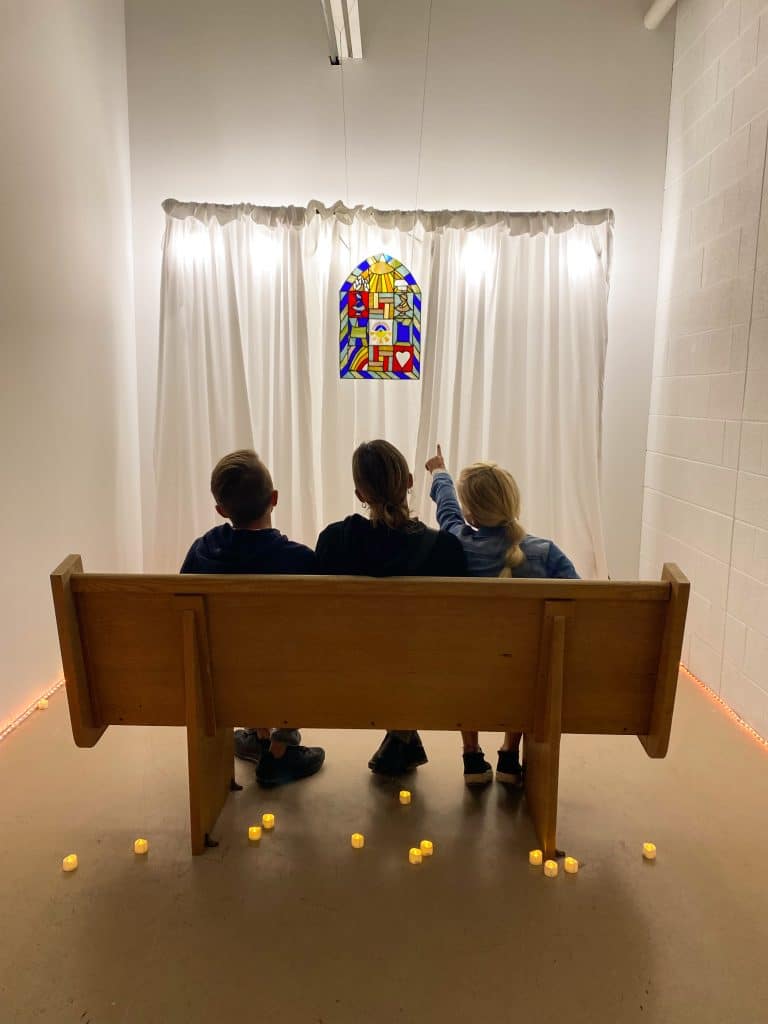
Legacy Window
Maddison Tenney is a queer Latter-Day Saint, artist, and activist. She grew up in Southern Oregon and is currently finishing a bachelor’s degree at BYU in English literature with minors in art and global women’s studies. She founded the RaYnbow Collective, a non-profit in Provo Utah focused on supporting the LGBTQ+ community at BYU. She also works as an artist and illustrator and shows across Utah in Provo, Ogden, and Logan.
Maddison Tenney
@maddi_10e | little-sun-design.myshopify.com
Categories: Preview
Comments (0)
No comments yet.