
I, CLAUDIA by Claudia Lauper Bushman
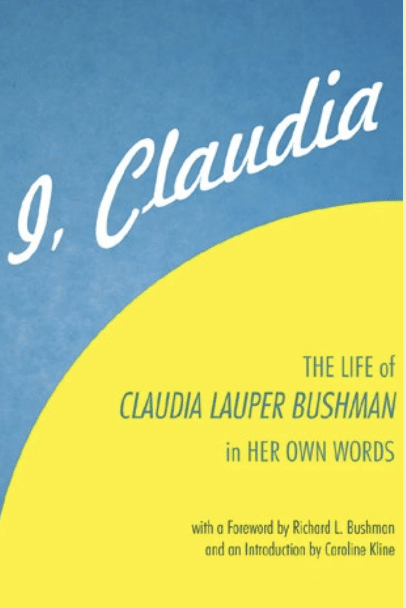
I, Claudia: The Life of Claudia Lauper Bushman in Her Own Words, Reviewed by Lori LeVar Pierce
It was a pleasure, in the midst of the celebrations of Exponent II’s 50th anniversary, to read Claudia Bushman’s autobiography, I Claudia: The Life of Claudia Lauper Bushman in Her Own Words (Greg Kofford Books, 2024). As the first editor of the newspaper, Claudia’s dictum that “If you don’t write it down, it didn’t happen,” has driven five decades of writers. She is well known and loved as the first editor of the Exponent II. And yet, the story of Claudia Bushman is so much more than being a Founding Mother. This behind-the-scenes story peeks into the life of a married LDS woman born in the early part of the 20th century. This first-person narrative opens the door to understanding what life was like for a married woman who longed for challenge beyond the home. Her frank commentary acknowledges the good and the difficult parts of her life.
This autobiography starts with the history of Claudia’s immigrant grandparents and great-grandparents, whose religious conversions brought them all to Utah. Her entire life was set against the background of the Church. She writes, “I lived my early life encapsulated in Mormonism. It was the foundation, the walls of my world.” She lived in this world and yet was also willing to push back against the typical expectations. She went from California to college in the East. She was always taking classes despite her protestations that she was not a good student. She worked her studies around her responsibilities as a mother, even though she indicated that one department chair “was not hesitant about telling me that I was an unsuitable candidate. As he said, ‘Oh, Mrs. Bushman. Why don’t you just stay home with your children!’ But this going back to school was what I wanted to do.”
The book is full of details about her children, the homes they lived in, and the communities they became part of. Despite many moves — even across the country — Claudia seemed able to find her place in each local community while also finding a way to benefit it.
the story of Claudia Bushman is so much more than being a Founding Mother.
I am most struck by the seeming contradictions inherent in being married to a man with significant positions at both church and in his profession. Claudia admits that being a bishop’s wife affords women some protection in being able to create special activities and programs without effective opposition, and this she did, as her mother before her had done. And in her secular world, she writes of many occasions where, thanks to her husband’s position, she was welcomed into social life and attended formal events, meeting very important people.
And yet, while her husband’s position afforded her additional freedom in some areas, it limited her in others. Because of her husband’s university positions, she was frequently unable to work as anything other than adjunct faculty due to nepotism concerns. And in Boston, she resigned as Exponent II’s editor specifically because she was told that her husband’s position as stake president would be in jeopardy if she continued. She shared that, after this incident, “It was too much when I was asked to write a piece for the church magazine, the Ensign, commenting on the ways a husband should sustain his wife in her callings — church, family, community, etc. I turned that down.”
That she bounced back from this exertion of patriarchal power is to be commended. This book details how — though she was heartbroken over it — she moved forward to create a life in the spaces left to her. She continued to find and be found by impactful projects that brought her great satisfaction and enjoyed teaching and mentoring students.
Claudia’s remarkable life and contributions to the world of women’s history, including the Claremont Mormon Women’s Oral History Project, are on full display in this book. Her work with the Claremont Mormon Women’s Oral History Project, which she founded, will have lasting effects. The details of her life mirror those of many of her contemporaries and her willingness to write it down gives us a record that prevents this history from being forgotten.
Categories: Book Review
Comments (0)
No comments yet.