
Creation
I’m still pregnant with my first child when I make a goal to attend graduate school.
“This is a female text,” Doireann Ní Ghríofa writes, “composed while folding someone else’s clothes.”
More specifically, this is a text written within motherhood — drafted to the sound of my toddler babbling into the monitor, revised much later alongside the rhythmic kicks of my unborn baby.
I’m still pregnant with my first child when I make a goal to attend graduate school. I decorate the nursery. I write my statement of purpose.
“Let other women pursue heedlessly what they perceive as their selfish interests,” Spencer W. Kimball said during his tenure as President of The Church of Jesus Christ of Latter-day Saints.
I grew up Mormon and learned that Church leaders speak directly for God. Although I no longer heed their words, their talks are a background buzzing. I hear them when the moving truck pulls up to our new driveway in a state away from home. I hear them when I meet my cohort and most of them are single people with big, individual goals, not wives and mothers.
A few days before the start of the semester, a group of undergraduate students step off the campus sidewalk when I round the corner with my stroller. The width of the stroller as my guide, finally, I’m not the one to yield first. My fifteen-month-old waves his puffy hand to each student. “Hi!”
I narrate our journey for my son.
“I think we’re almost to our building,” I say. “Oh, looks like there’s no ramp at this door!” He shifts a little, and I walk faster, both because of my own excited energy and because I know his wonder for this particular adventure will fade in the amount of time it takes him to finish his last three puffed rice crackers. Soon, we enter the old dormitory-turned-graduate student office building, and then rise up to the second floor and wheel down a hallway that I suspect breaks some sort of code, to a door marked 212, which unlocks with a turn of my new key.
“Yay!” I say, and I hold the door of my new office with one hand and slide the stroller through with the other.
“Hi!” my baby chirps to no one. Below the semi-functioning sink, worn duct tape patches the putting green carpet. Beyond the window, where paint peels off the sill and Christmas ornaments so old they disintegrate in my hands dangle, I see a coffee shop across the street, students attempting to set up a hammock, students reading on the grass. A couple weeks from now, the office desk will house framed pictures of my family. Thumbtacked to the wall, a giant outline of my next school project on banner paper will cover the yellowing paint. I stroke my child’s cheek.
Graduate school brings fulfillment just for me. I pursue a degree in the humanities, so there’s no promise of sudden financial security, and nearly all of the stipend I make from teaching goes back into part-time child care — something I’d always heard described as “paying someone else to raise your children.”
I feel both privileged and guilty, proud and self-conscious. What am I trying to prove? To whom?
Kimball continued, “Do not . . . make the mistake of being drawn off into secondary tasks which will cause the neglect of your eternal assignments such as giving birth to and rearing the spirit children of our Father in Heaven.”
I learn that I’m a cry-in-the-parking-lot-after-daycare-drop-off type of mom. I remember that I’m a take-color-coded-notes-on-everything type of student.
I love school, and I worry every day that there’s some truth to the buzzing: that my child will resent me for these hours apart, that loving something in addition to him pulls love away from him. I hope following my ambition makes me a better mother; I hope it makes me a better person. I don’t know when I’ll have the answer, but I choose to have faith that decisions I make for myself aren’t inherently against my child.
“Wives,” Kimball said, “come home from the typewriter.”
Motherhood makes me a slower writer, but a more multidimensional one — probably because I’ve become a more multidimensional person. It brings out the extremes in me. Every moment as a mother is wrapped in both fear and love, always in all ways. I can no longer wait for inspiration or the right mood to create; I draft during nap time, centered in a room where frozen trains wait to once again circle the furniture from the guidance of tiny hands. In the moments that are just mine, I am a strong version of me, and when I finally write a line that I’m proud of, I pace around the room, weaving between LEGO castles because I’m too energized to stay in my chair, and then I sit back down. Because I want to do it again. And when those tiny hands return, ready to bring the trains back to life, I switch modes too, despite being in the middle of a sentence, and together my son and I take that train track farther than it’s ever been before.
And then my son is pulling free every single hand-placed tab from every single book on our bookshelf. I lunge, irritated that he can’t just let me romanticize my books while he flips through the children’s pages I arranged at his knees. I pause, realizing that tab-pulling could give me just enough time to catch up on student emails. Besides, all my books are highlighted anyway — tabs are overkill.
He resticks the tabs on new pages, and I leave them there. Maybe one day a colleague will borrow the books and try to find some intelligent pattern in the annotations.
“Come home, wives,” Kimball said, “to your children, born and unborn. Wrap the motherly cloak about you.”
I don’t know what a motherly cloak is.
My son and I sit side by side on the living room floor. I’m looking up ways to toddler-proof a bookshelf. All of the suggestions seem to be written by people who have never been around children. Next to me, he pushes himself off the floor, still wobbly, then, bum first, backs onto my lap. I kiss his hair. He turns and lifts his head toward me, lips pursed, and when I bend down he kisses my lips, and his kiss is big and wet and mostly tongue, and maybe a little puffed rice cracker, and when he pulls away we’re both grinning, and I don’t know who smiles first.
It is magic to witness every moment of childhood, to watch my son in the first weeks of spring pluck an acorn, which he’d buried last fall, out of our flowerbeds, his eyes aglow when he sees a tiny sprout poking out the bottom. He runs to me, barefoot on the grass, acorn clutched in his fist, messy blond hair flying. And I am there to catch him, to hold him while we examine the tiny bits of life in his hand.
Motherhood expands me. I don’t want it to cloak the parts that existed before. I don’t want motherhood to make me unrecognizable to myself.
“This is a female text,” Doireann Ní Ghríofa writes, “written in the twenty-first century. How late it is. How much has changed. How little.”
Many of the boldest comments about a woman’s role in the Mormon church were said by leaders in the mid-20th century. Still, because the Church claims their leaders speak to God and that God’s ways are never changing, decades don’t neutralize the venom. These leaders and talks are regularly referenced; their messages taught through slightly softer euphemisms. The average member still raises their eyebrows when a woman clarifies that her family moved for her graduate school, not her husband’s. Small talk at the dentist still starts by asking what my husband does for work before inquiring anything about me.
My school backpack is technically a diaper bag. It is full to near bursting with a constant rotation of items: books and notebooks and essays and student papers and lesson plans and folders and my planner and pens and backup pens. I invite my cohort, who are now my closest friends, to my son’s second birthday party. The final projects of the semester are due this week, but one friend still takes time to bake a cake; another writes a birthday poem. Together, we all fly kites in a field behind our house. My toddler giggles while the string unravels through his fingers, and I swear I’ve never seen kites fly higher. o
Alyssa Witbeck holds an MFA in creative nonfiction writing from the University of Montana and crochets an excessive number of stuffed animals for her two children | alyssawitbeck.com
Art by Alise Anderson:
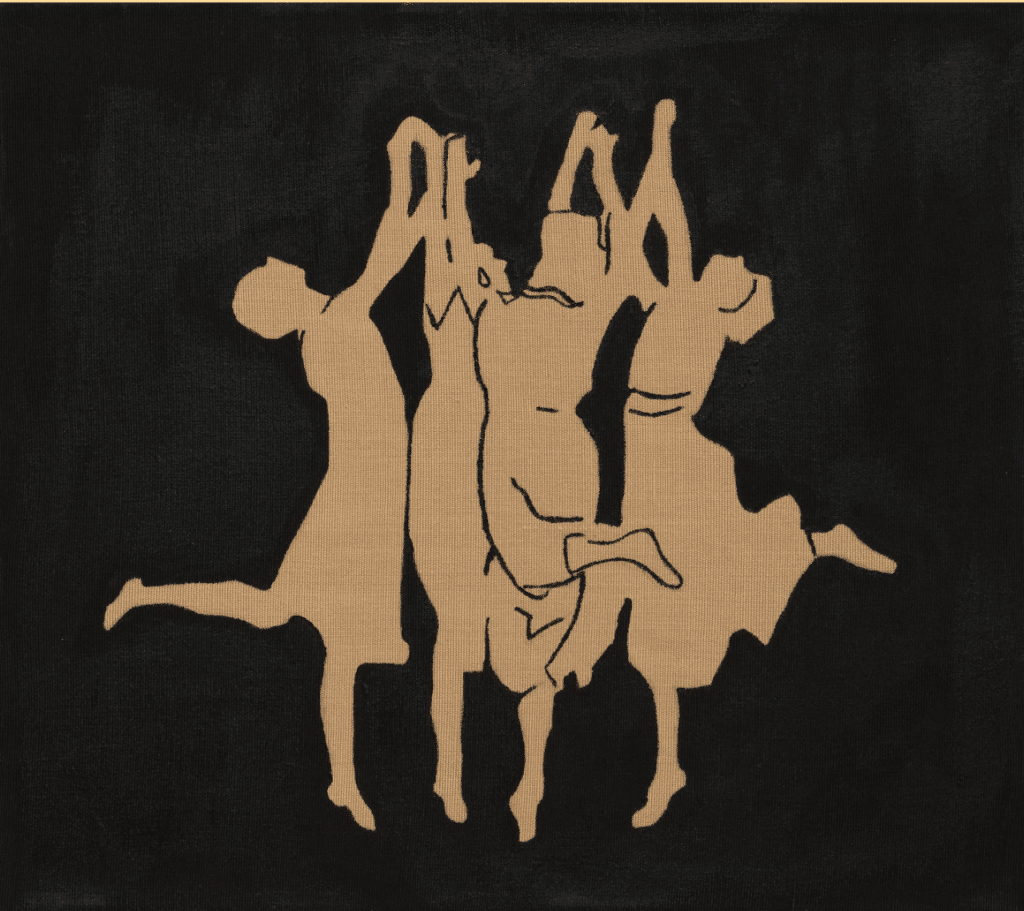
Queer Joy
Acrylic on linen, 16 x 16 in.
I’m an interdisciplinary artist working with textiles, photography, sculpture, and video. My practice draws on family archives, religion, and personal history to explore the absurdity within the familiar. Humor is central — it opens space for tenderness, critique, and survival. In Unruly, the larger collection that includes Queer Joy, I rework a Mormon girls’ handbook into a reimagined queer field guide, celebrating queer joy. I often use labor intensive practices and repetitive handwork as a way to process and reflect. I want my work to make people look again — to find meaning in what’s overlooked, to hold contradictions, and to reconsider how personal histories shape us.
Alise Anderson
aliseanderson.com | @aleeeese
Categories: Preview
Comments (0)
No comments yet.