
White Mother, Black Sons
I now understand what every Black mother always understood — that my sweet baby boys . . . were not boys anymore but were Black Men.
The summer after kindergarten, I played outside every day in the haystack where loose straw and bales of hay became a playhouse or store or school. One day my path was blocked by a White Leghorn hen, her head bobbing forward with each step as a line of baby chicks followed. It occurred to me that I could just step over the line. As I lifted my foot, the hen misinterpreted my intentions. She came at me with her wings spread wide like brooms, screeching and scratching my face. She pecked my palms and forearms, then chased me as I turned to run. Her cries followed me as if to say, “. . . and don’t come back.”
I was scared and the scratches burned, but more than that, I felt misunderstood. I didn’t want to hurt anyone; I just wanted to play in the haystack. I suppose my mom heard me crying because she met me at the back door. My mother wore work jeans, dusty cowboy boots, and a fierce defense of her little girl. When I told her what happened, she didn’t offer sympathy or comfort but grabbed the broom resting against the porch wall and marched out the back door. I immediately stopped crying and ran after her purposeful strides. When we got to the barn, the mother hen was waiting, her babies hiding behind her spread wings. Mom lunged into an attack with her broom, sweeping and beating until the hen turned, tucked her babies under her wings, and scurried away. That day, I learned my mother would go to battle for me.
I always thought that, like my mother, I was the kind of mom who could confront any dangers facing my children. But I found myself impotent, never understanding the world beyond our home when raising biracial sons in the city.
***
On June 1, 2020, I was home watching TV as people took to the streets with pent-up frustration and cries for justice. A young girl’s video of the public lynching of George Floyd on Memorial Day placed his death in perpetual present tense, and outrage spread as quickly as the coronavirus. We watched as an adult Black man lay prone on the pavement, a white officer kneeling on his neck as though he had wrestled a steer. The man gasps, prays, says, “I can’t breathe” 30 times. He calls for his mother. He dies. I watched, my head dropping to cower as though watching a horror movie. A knot in my chest took my breath but I chose to watch to the end.
That choice is a luxury.
As protests and riots continued, my son Marcus called from an empty parking lot outside the pest control company’s offices where he worked in Tucson. Everyone from that office had left for California, where Marcus was to join them the next morning. He called me as he tried to request an Uber to take him to his motel, but riots were everywhere, and drivers who had taken the ride immediately rejected the pickup. Marcus was mad everyone had left before him and scared of the turmoil around him. I was a terrifying 650 miles away, helpless to protect him. My mind thumbed through the scenarios I had naively never considered before. What if the police think he’s trespassing? Marcus likes to talk aloud to himself when he’s working something out in his head. What if a concerned citizen calls about an erratic Black man in the area? Wasn’t Stephon Clark shot in his own backyard because police had mistaken his cellphone for a gun?
I tried to coach him, “Calm down, Marcus.”
“I’ll be okay,” he said. “I just want to get to my room.”
A Lyft driver accepted the ride, but the pickup spot was in a nearby neighborhood that was surrounded by a fence.
“I’ll just jump this fence,” he said.
“No, don’t jump any fences!”
“I’ll be fine.”
Marcus knew his intentions. He didn’t want to hurt anybody. But I knew of neighborhood watches, citizen’s arrests, and Stand Your Ground laws. My son is tall, broad chested, and has a perpetual five o’clock shadow. I know he isn’t threatening, but people in this neighborhood may not see him this way. I closed my eyes and kept talking while listening to his panting breaths on the other end as he walked briskly to the spot where he met a Lyft driver in a Toyota Sedan.
***
I’d married a Black man without a second thought to the differences in our race, and my husband B and I rarely talked about it. His dad never articulated dangers to him but demanded certain precautions, which B followed with fidelity. Don’t give anyone a reason to look at you. Be early for appointments. Make sure your vehicle works correctly. Never give the law any reason to pull you over. All registrations, licenses, and insurances must be current. Blinkers, taillights, and headlights must be fully functioning. Never speed. Always signal. My husband hardly ever got pulled over, and when he did, he was calm when interacting with police officers.
Car registration was last on my to-do list, and when B mentioned it, I casually explained that no cop would pull me over for being only one month past the due date. I’ve had so many speeding tickets that I’ve been suspended. Twice. The consequences were manageable and hardly life-threatening. These topics often started fights between us. I wondered what his problem was. I now know that I was flaunting an ability to behave however I wanted in a world where he could not. How could that not make him angry or resentful?
B’s dad gave me a book about Emmett Till when I was pregnant with Marcus. Here I was, an educated 37-year-old woman, and I’d never heard of him. The horror was disorienting, but I reasoned Jim Crow was no longer the law, and so the Black men in my life were okay. But then the next year, 1998, three white men asked James Byrd Jr. if he needed a ride home, then took him out on a country road where their violence and abuse were topped off by wrapping a chain around his ankles and dragging him behind their pickup for three miles. Forensics determined he was alive and conscious for most of this, until they took a corner and his body slammed into a culvert, severing his right arm and head. The details were horrifying, but that was Texas, a long way from Utah.
In 2012, news of other murders came quicker, closer, and moved steadily over the map — Trayvon Martin, Eric Garner, Michael Brown, and 12-year-old Tamir Rice, who was playing with an airsoft gun, shot seconds after the policeman left his car. At the time, Tamir was only two years younger than my son Quentin. After every Black life was lost, I’d want to understand. I couldn’t wrap my brain around it. When I asked B for help comprehending, he only told me of grade school fights he’d had after being called the n-word on the playground. He told me of Black college teammates who accused him of not being Black enough or of acting white. All I knew of him was the now of our lives together, and I foolishly thought his race rarely came into that.
The killings got closer. That same year, in Saratoga Springs, Utah, just 30 miles south of our home in West Jordan, Darrien Hunt was shot outside a Panda Express while swinging a sword. Marcus also loved swords and superheroes and video game scenarios. I told B I was scared, but he mostly lacked the words to talk about it further, and I struggled to listen to what he could not say.
***
When he was 15, Quentin transferred from a suburban school, where he’d grown up with mostly white kids who didn’t talk about race, to play basketball at the inner-city school in Salt Lake where I taught, where the majority is the minority and 64 percent of the student body is Black or brown. He set out right away to make friends with the same demographic he knew from grade school and junior high, but while playing a game with a group on his phone, the host kept kicking him out. Quentin was frustrated because he’d been making gains and then, poof, it was all gone. He told me this boy was racist; I asked, “Are you sure?” He explained that he was, but I didn’t listen. It’s just a game, I thought. Certainly, it’d be okay. But I didn’t know that early after his transfer, he was at the lunch table when this boy said to him, “You know what I hate? N—–s.” And everyone laughed, including Quentin.
He tried to brush it off and make friends in classes, the lunchroom, the basketball team, but the circles were too tight to break, and those who let him in pelted him with racial slurs, adding, “You’re okay with it, right?” They expected him to befriend the other Black kids on the basketball team, but he had little in common with them except their color and size. Every day as he walked to math class, boys lay in wait to pass him in the hall and call him racial slurs. They called him these names as he stood in the stands at football games. They created parties where the invitations said, “White girls only.” Their words methodically pulled him apart like wings and legs from a grounded butterfly. Then one day, while asking someone about a particular game on his phone, he was told, “You’ll speak when you’re spoken to, n—-.”
Before his senior year, Quentin had hip problems, the precursor to discovering an autoimmune disease, which kept him from basketball. He told me he wanted to return to his home school. But he was president of the jazz band, and I didn’t want him to shirk that duty. That’s when he told me all the stories that happened in the school halls where I taught. Where art and pictures of African American leaders and athletes filled the white spaces of cinderblock, along with quotes about working together and reaching for the stars. If my son wasn’t safe here, where I taught every day, no one’s child would be safe. What happened to Quentin laid bare a world I could never and would never know.
The principal wanted proof, but what proof was there? He dismissed the previous two years of abuse as a product of a few bullies and wanted names. The problem wasn’t just a few misbehaving students, but rot at the root of the tree that made up the student body of the school where I’d worked for 15 years, where I’d come to love the kids I taught. The principal informed us we could press charges. B thought they’d target our house. Quentin was afraid of social media and further ostracization. In school and out, he held his breath and hoped they would leave him alone.
Nothing was done. It was as if it never happened.
***
One of the tools mothers might use in raising children is religion. I know my mother did, and I, too, took my children to church every Sunday, to sit in pews and listen to talks about kindness and love. Religion can offer a clear set of values and simple rules that promise asylum from all looming worldly threats. The children’s song, “I Am a Child of God,” speaks to individual worth and a knowledge of Heavenly Parents who love and care for them. I hoped their religious upbringing would affirm their divine value and give them a community of people singing the same lyrics, solidifying the belief that we are all heavenly siblings. Of course, some of those who taunted Quentin or laughed along as it happened were also Mormon, young men who believed God loved them most for their complexion.
This church is the one my mother loved, that colored my world as a child and guided many of my choices; yet this church also denied people like my sons full priesthood rites until 1978, when I was a senior in high school. Growing up, I’d asked my mom over and over why they couldn’t hold the priesthood. She echoed what she’d heard — they’d done something in the pre-existence. “What thing?” I asked, but I was told we don’t know. This wasn’t doctrine, but it was the story members told themselves. Of course, as a girl, I couldn’t have the priesthood either. Members claimed that we had motherhood, the highest honor, and this kept us in place. But because of the things I love about this religion and the culture of the pioneer women who went before me, I overlook many things that I abhor. This cognitive dissonance isn’t lost on me — that the thing I have clung to as safety for my family makes me complicit in structures that also caused harm.
I now understand what every Black mother always understood — that my sweet baby boys, both with deep dark eyes that looked at me and laughed as I caught them in my arms at the bottom of the slide, whose heads would lay against my chest as I read a story or sang James Taylor songs while I played with the curls on their heads, were not boys anymore but were Black Men. My sons could be shot for wearing a hoodie while walking to 7-11 for Skittles late at night. My beautiful boys could be shot for wandering the floor plan of a house while it’s being built. My sweet young men could be knelt on, put in a choke hold, and convinced that if they’d just confess to something they didn’t do, they could go home but end up spending decades in prison.
***
Tonight, I watch TV as riots flame in cities and streets, and I fully understand this desire for a conflagration that can make the largest disturbance possible. I fantasize about marching into the school at night, baseball bat in hand, and breaking every window, flipping desks, demolishing every trophy, taking a knife to the principal’s office chair, pulling down the banners and awards, spray painting the mascot’s statue in the Commons, then advancing to the football field where I’d burn my son’s name into the grass, a giant Q that would flame so bright and loud that it would allow my son to breathe.
Elaine Turner teaches Freshman English at College of Southern Idaho and skiing at Pomerelle. She currently lives with her parents, where she cares for them and her old dog (@elainetlamb). Book Rec: Down Girl: The Logic of Misogyny by Kate Manne
Artwork by Marlena Wild:
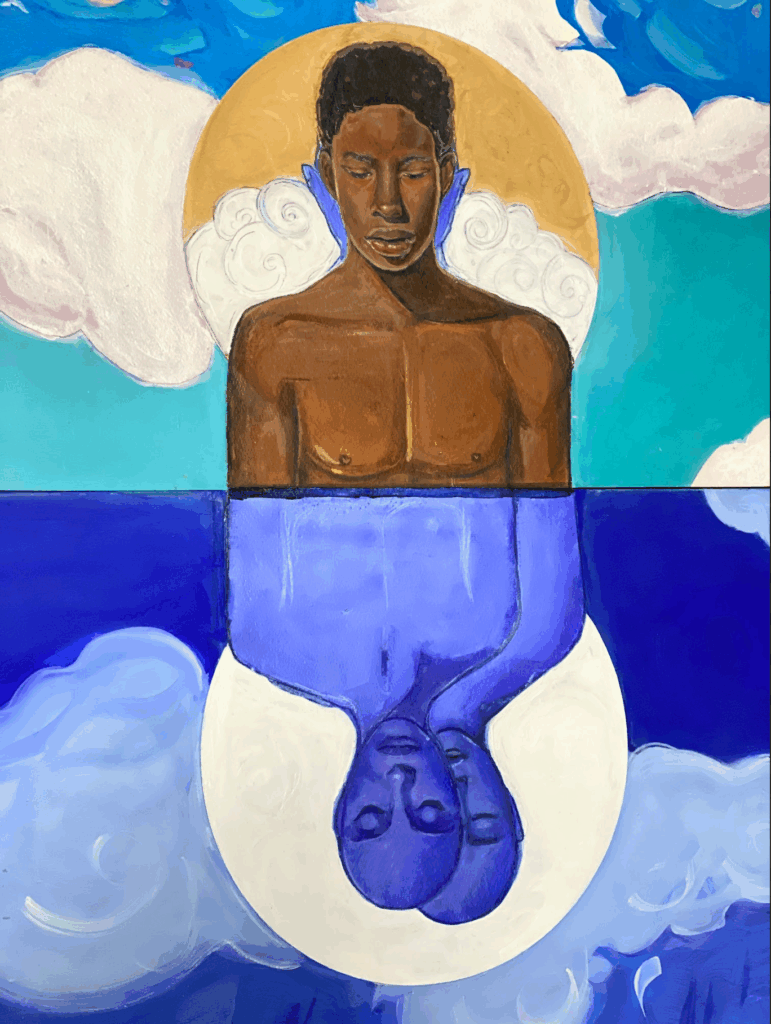
ARTIST STATMENT
In God(s) Image
Mixed media collage on wood, 24 x 36 x 1.5 in.
In God(s) Image reflects on divinity as both unity and multiplicity. The canvases mirror one another, suggesting that light and shadow, masculine and feminine, above and below, are all held within the same source. The figures rise and descend in a single breath, reminding us that every soul bears the imprint of the divine. By naming the work God(s), I honor the many faces of God, the countless perspectives that together form the whole. It is a meditation on oneness, forgiveness, and seeing the sacred in all beings.
Marlena Wild (marlenawild.com, @marlenawildart)
Categories: Preview
Comments (0)
No comments yet.