
The Ward Librarian
Looking at those empty shelves, seeing the pictures and music in that dumpster, it was never clearer to me that my participation did not matter to ward leaders.
It was Mother’s Day. I had been enjoying our Mother’s Day treats in the gym. On my way out of the building, I passed the library. I was shocked to see two bishopric members inside. They had two large rolling garbage cans and were in the process of filling them by emptying the shelves indiscriminately. The shelves that held all the choir music purchased over at least 25 years — empty. The shelves that held those precious out-of-print 11 x 17 pictures Primary teachers love — empty. I might have raised my voice a bit when I asked, “What are you doing?”
They told me the remodel was starting that week and they had been instructed to empty the library. I have no clear recollection about the pitch of my voice when I asked, “Why didn’t you come ask me what gets used and should be kept?” Their response? “We didn’t want to bother you.”
***
Ten years earlier, I hadn’t been happy when my bishop called me to be in charge of the ward library (now referred to as the resource center). It seemed like he wanted to curtail my frequent comments in Sunday School or Relief Society. I had always held music, presidency, or teaching callings prior to this. I really didn’t know what a church librarian did other than collect books and pictures for patrons.
I worked to feel better about my calling. I figured out how to use the copier to also print, thus providing professionally clean copies of lesson manual pictures. They looked much better than the grey-cornered copies made from manuals teachers had before. I kept the large 11 x 17 picture inventory in numerical order, and showed teachers how to use the printed index of all pictures to easily find a picture they wanted. I made sure I had the office supplies that teachers and I needed. I handled donations of books — adding what was appropriate and finding good homes for books that didn’t belong.
After getting used to seeing me behind that waist-high counter in the library, ward members often came to visit with me during the second hour of church. Many of them brought me their electronic devices to troubleshoot. I had a lot of excellent conversations in the library. Some teachers even appreciated my efforts enough to text me on Saturday night or Sunday morning to ask me to have a particular picture selected or handout printed for them between Sacrament Meeting and the class they taught.
I served in that calling for nine years before they finally asked me to do something different. I wasn’t released from the library, but I began serving as the ward music chair and sacrament meeting chorister as well. When the church started releasing new hymns, these two callings came together in a beautiful way. As I had easy access to the copier/printer and the library storage, I took the single PDF copies of newly released hymns in both English and Spanish, added page numbers, and printed them to create folders for the chapel so that we could sing them on a regular basis. Many ward members told me they loved singing those new hymns, as did I. Compared with the 1985 hymnbook, these hymns are not only more enjoyable to sing musically, but also more culturally representative.
This April, they decided that a decade in the library was enough for one person and it was time to give that responsibility to someone else. Given how difficult the calling had been for me to accept, I was surprised at how sad I felt. They asked me to walk away from a space that I spent much time and effort making meaningful. Offhandedly, the bishopric member releasing me also mentioned that the library space was soon to be redesigned. The resource center would be smaller and the family history center would expand.
***
Those two men, who had barely — if ever — stepped foot into that library, had decided what would be kept and what would be thrown away. The choral music and the pictures, what I saw as the two of the most precious things in that room, were gone. Both had already been dumped into the outside dumpster. In a small concession to the fact that I had knowledge they didn’t, they did go to the outside dumpster and salvage what they could of the pictures and the music. A very small fraction of the music was found, and while I do think most of the pictures were rescued, they were out of order, and I’m sure that the carefully typed-up 10-page index was forever lost.
Looking at those empty shelves, seeing the pictures and music in that dumpster, it was never clearer to me that my participation did not matter to ward leaders. In two minutes, I could have identified exactly what was considered valuable by ward members and what had not been touched in years. They had not valued the knowledge I held — I spent a decade of Sunday hours in that room — enough to walk just 20 feet to ask for my advice. Thinking about why they believed doing it this way would be better still keeps me awake at night and away from the church building. If they had been willing to ask and listen for just two minutes . . .
***
The Sunday before that Mother’s Day was our monthly fast and testimony meeting. It had been a few months since I felt moved to share my testimony publicly. My testimony differs from how most church members think about the gospel and so often confuses rather than uplifts them. However, on that particular Sunday, I felt moved to speak.
I had been reviewing stories about the life of Lavina Fielding Anderson — a writer who was excommunicated in 1993 because of an article she wrote about ecclesiastical abuse. She gathered data and wrote about LDS leaders who used their positions to limit the involvement of members based on differences of opinion over Church doctrine. Despite being excommunicated, Lavina attended church every Sunday until her health declined around 2020. I mentioned her by name in my testimony. I talked about having a testimony of the gospel, if not always of the Church organization. I have consciously followed Lavina’s examples of continuing to attend church for myself. I shared that many of my friends and even family members had chosen to walk away from the Church because they felt it no longer encouraged them on their spiritual path. I mentioned a time, 25 years earlier in a different ward, where we had attended weekly only out of personal commitment to attend. There were many times when attending and participating was extremely difficult. I shared my testimony of belief in Heavenly Parents and a plan of salvation. I shared that I believe individuals could continue to attend church for their own personal reasons, even when church is hard, like it was for Lavina, a woman whose contribution was so rejected by church leaders that she was barred from contributing again. And I know the stake president was listening because he quoted part of my testimony in his — though it was just the part about continuing to attend church.
***
I don’t yet know how this story will end. As I write, I have not returned to my church building, but I may have by the time you read it. I meant it when I publicly committed myself to attend church for personal reasons, even when it is hard. I will, most certainly, redraw some new boundaries around my church participation in the future. I am still wrestling with exactly what those boundaries will be.
When I return, things will be different. From what I hear, my ward has not sung any of the new hymns since Mother’s Day. I have let go of any expectation that the men in charge will be seeking my input or willing to listen to things I could tell them. And I am anxious about how it will feel to walk past that library space, to see how the men in charge have redesigned and reduced it.
Lori LeVar Pierce is the current president of Exponent II (@lorillp). Book Rec: Mercy Without End: Toward a More Inclusive Church by Lavina Fielding Anderson
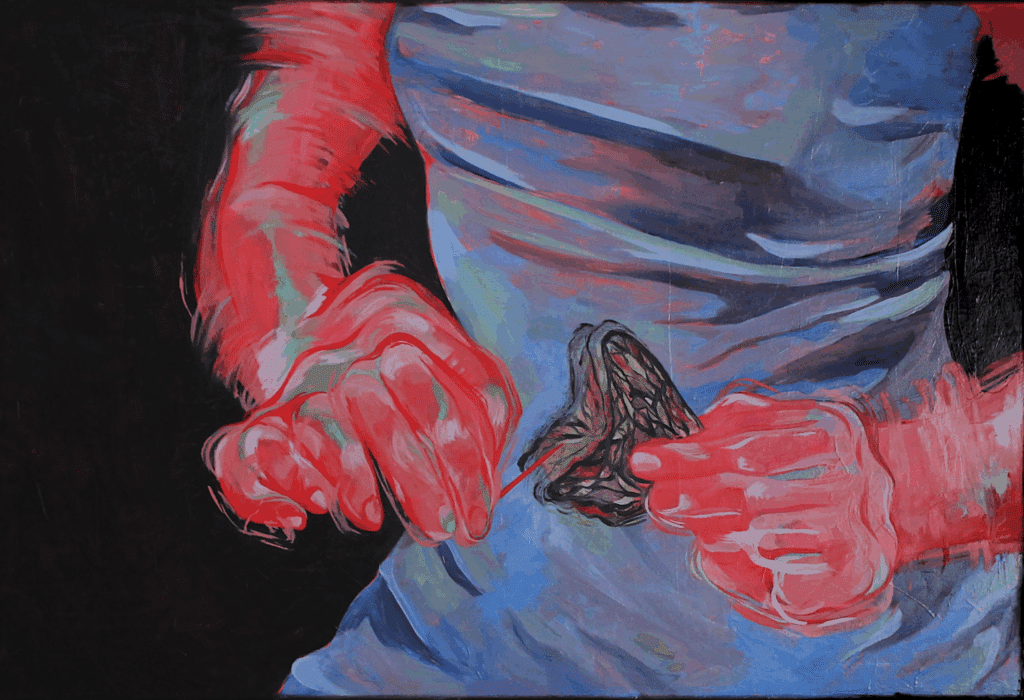
Artwork by Megan Bentley Atwood:
ARTIST STATEMENT
Feminine Fragility
Oil on canvas, 36 x 24 in.
Feminine Fragility is an oil painting that portrays a woman hastily attempting to mend the delicate wings of a butterfly. Her hands, though brimming with care, move with urgency. This intimate scene reflects the paradox of feminine care: tender and devoted yet often pressured and hurried. The act of repairing a butterfly is ultimately futile, yet she persists, embodying both the impossibility and the quiet beauty of such devotion.
Megan Bentley Atwood (megbentwoodart.cargo.site, @megbentwoodart)
Categories: Preview
Comments (0)
No comments yet.