
Undoing the Ideal: Stitched, Scarred, and Sacred
In my early 30s, I found myself going through a divorce. Up until this point, I’d followed the script for how my life was “supposed” to go: I graduated from seminary, married in the temple, graduated from BYU, and had two beautiful children.
Facing an uncertain future as a single mom, my life felt like a broken mess.
I tried to pick up the pieces and chart a new path my conservative LDS family of origin struggled to understand. I found a job, supported my kids, continued serving in callings, and tried to enter the LDS dating world. It was a rough adjustment for us all. Like many newly divorced women, I probably focused too much on my looks. It felt impossible to raise my children alone, and I fell into the belief that my physical beauty was a central piece of attracting an eternal — for real this time — companion.
After a particularly devastating break up with a man I thought I would marry, I decided to get breast implants. It’s hard to say why I did it exactly. My mom had had the surgery a decade prior, and she talked about every post-breastfeeding woman “deserving” them. While the feminine ideal of the ‘80s and ‘90s was both thin and voluptuous, I’d always been small-chested. Breastfeeding two babies hadn’t enhanced my body. Around the same time, a friend in the LDS singles world got implants, and she was open about how it increased her confidence. It all seemed very casual and simple. And at first it was.
After seeking a referral from my friend, I contacted her surgeon in Salt Lake. At the consultation, the surgeon said I was a good candidate. She glossed over any potential complications or health risks, and I scheduled the surgery. Recovery was fairly quick, and for the first few years, I was happy with the results. I was able to wear clothes I’d never been able to wear before and felt “sexy” in a new way.
I realized then how quickly cultural ideals move, while our bodies are left to absorb the consequences.‘
But other clothes, like the sundresses I’d enjoyed wearing before, just didn’t work with the shape of my body anymore. Still, the sundresses remained in my closet because I didn’t have the heart to get rid of them. Ironically, a few years later, trends shifted and smaller breasts became more fashionable. I realized then how quickly cultural ideals move, while our bodies are left to absorb the consequences.
Increasingly, it felt strange and sometimes painful to have something plastic and foreign beneath my skin. As I approached my late 40s, more serious health issues began arising. Sometimes the area around the implants became extremely painful. My shoulder, on the opposite side of one implant, began cramping on a near constant basis. Wondering if my symptoms might be related to the surgery, I read about Breast Implant Illness online, and everything clicked.
How had I never heard about this before? Had the surgeon mentioned it to me? Perhaps she did, and I hadn’t wanted to listen. I realized too late that the list of potential health impacts from implants are long and sobering. Some women experience chronic fatigue, joint and muscle pain, brain fog, autoimmune-like symptoms, recurrent infections, and persistent inflammation. While the medical community continues to debate the issue, a growing number of women describe significant improvement after implant removal, raising important questions about how the body responds over time to foreign materials.
There is a real financial impact, too, as surgery costs have skyrocketed in a post-Covid world. I learned that no matter how severe health complications become, implant removal is rarely covered by insurance if they were originally placed for cosmetic reasons.
I reached out to my mom and asked if she’d known about these health complications and was dismayed when she said, “Oh, I was hoping you wouldn’t have this happen. I’ve had many friends who have gotten sick from them. I was having health issues, too, but they got better once I had them removed.”
I was stunned. “Why didn’t you tell me before?”
“You were so excited about it,” she replied.
I felt slightly sick as I hung up the phone. While the decision had been mine, I still felt angry over her lack of transparency. I wish she had been honest with me so I could have made the choice with all the information.
More determined than ever to have them removed, I went through the process of finding a new surgeon and underwent implant removal surgery a few months ago. Now, at age 50, my recovery has been difficult and slow. Removal was far more painful than the initial surgical procedure. I had to have drains placed at each breast that needed emptying several times a day. For several months now, I’ve battled low energy and near constant pain around the incision sites.
On the upside, my shoulder feels better, able to fully rotate for the first time in a decade. When I look in the mirror, my breasts are deflated and small, but they are also completely natural. I can wear those sundresses again — or I will soon be able to. I love my natural body, and I have no idea why I once felt like I needed to slice it open to fit some external ideal of female beauty. Well, I do have some idea about why I once felt that way, but over the past decade, I’ve teased apart and rejected many of the assumptions that once influenced my thinking.
No matter how often we tell women their looks don’t determine their value, there are clearly still aspects of LDS culture that continue to teach them otherwise.
I won’t judge any woman for deciding what is right for her own body, but I do wish someone had been open with me about how serious breast implant surgery is, especially when it’s done for strictly cosmetic reasons. It’s expensive and often leads to additional surgeries down the road. It’s invasive, painful, carries significant health risks, and recovery from implants or implant removal can be difficult — it certainly was for me.
I’ve been honest with my own daughter throughout the removal process. When I confessed that I had implants and was having them removed, she laughingly admitted that she always hoped her breasts would get bigger after she had kids (since she assumed mine were natural). I trust her to do what is right for her body, but she knows I think she is perfect exactly as she is. She’s chosen not to be active in the LDS Church, and I support her decision about that, too, though sometimes it’s painful.
Utah and Idaho have among the highest rates in the country for cosmetic breast implant surgery. The connection between LDS culture and high rates of cosmetic procedures and body dissatisfaction has been demonstrated repeatedly, including a recent study by the Utah Women and Leadership Project. No matter how often we tell women their looks don’t determine their value, there are clearly still aspects of LDS culture that continue to teach them otherwise.
In communities where marriage and motherhood are central goals, physical appearance naturally takes on heightened stakes. A subtle but persistent narrative also suggests that personal righteousness manifests outwardly. When beauty is intertwined with worthiness and community belonging, it’s not surprising that women might seek surgical solutions to close the gap between their natural bodies and the ideals they feel expected to embody. I can’t help wondering what would happen if we focused more on the values of authenticity and acceptance instead.
In or out of the Church, a myriad of cultural forces often shape what we believe will make us worthy, lovable, or secure. My hope is to allow more space for women to examine where our desires are coming from and consider whether they are truly serving our long-term health and wholeness.
As I look back, more than anything, I wish I had somehow been able to reach into my future heart and access the wisdom I’ve finally landed upon — the realization that my scarred, stretch-marked female body that gave birth to two incredible humans and sustained them both is incredible.
It is magical, powerful, and perfect exactly as it is. It is fashioned in the image of my Heavenly Mother, the Creator, and my procreative power connects me with Her and with all women (whether they physically give birth or not). The truth is, love was never something I had to earn. When I look at my breasts now, it is this inherent magic, beauty, and power I choose to see instead.
For more on LDS culture and plastic surgery, see: https://www.usu.edu/uwlp/files/snapshot/63.pdf
Mary Alice Robbins is a writer based in Oregon. Her favorite titles are Writer and Mom. Book Rec: The Opera Sisters by Marianne Monson
Art by Ocean Blue Taber:
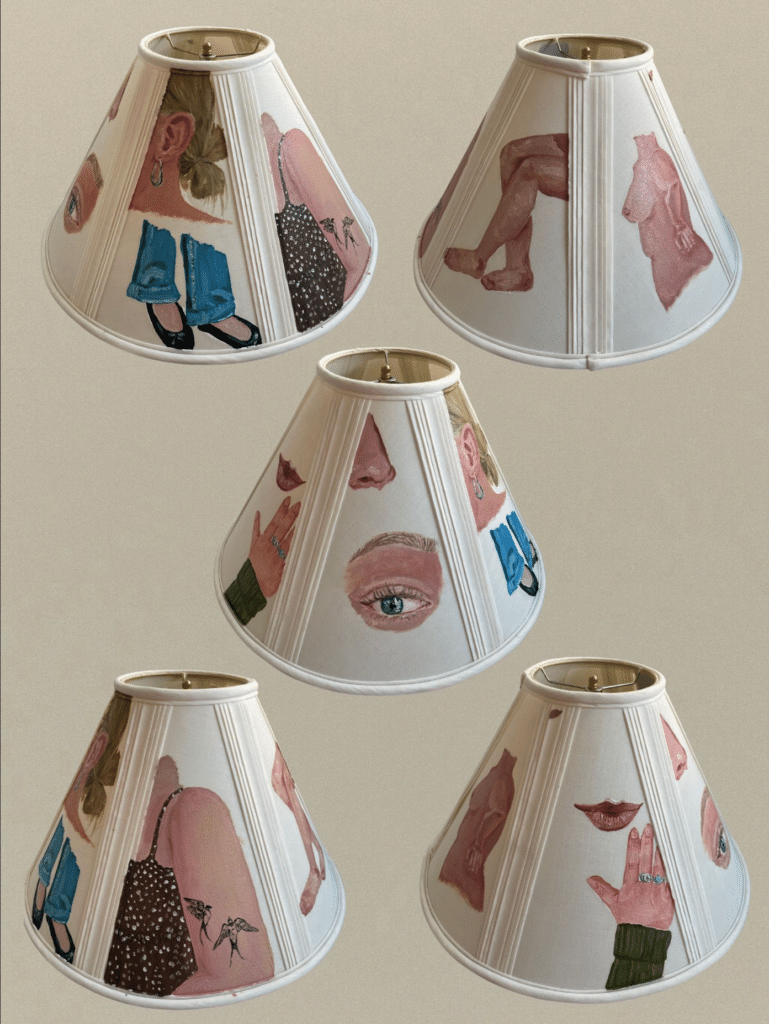
ARTIST STATEMENT
My Body is a Temple
Oil paint on linen lampshade, 1.5 x 2 ft.
This lampshade was sourced from Deseret Industries, a Church-owned thrift store. On it I painted fragmented parts of my own body as a way to take ownership of the vessel that gives me life. I wanted to explore 22 years of feeling disconnected from my body due to religious trauma. Growing up I was taught that I did not have ownership of my body, that sexual exploration and eroticism was a sin, and that I was at the disposal of men (including a Male god) and my future husband. I was told how to dress, what to eat, and that my body was a “temple.” Years of indoctrination have made me lose touch with self love and acceptance.
Ocean Blue Taber
@oceanblueartistry
Categories: Preview
Comments (0)
No comments yet.