
Crossing the Finish Line: Why Our Sisters Need a Different Race
There is a specific kind of electricity in the air at the Missionary Training Center. It smells like starch, anxious sweat, and the burning desire to be exactly who the Lord needs you to be.
I was 21 years old, glowing with fervor, and sitting in a stiff plastic chair when Elder Jeffrey R. Holland walked to the pulpit. The room, filled with thousands of nametags, went silent. He spoke with that characteristic thunderous passion — the kind that makes your ribs vibrate and your breath catch in your throat. He told us a story about a marathon runner — someone who pushed themselves so hard, gave so much to the race, that upon crossing the finish line they collapsed and threw up.
He looked out at us, his eyes burning with the intensity we all loved, and told us to “run to the tape.” He told us not to leave anything on the table. He told us that the Lord deserves our everything.
I took that message into my bones. I am a woman who loves God. If throwing up at the finish line was the metric for faithfulness, then I was prepared to hemorrhage everything I had.
I didn’t know then that my body, unlike the marathon runner’s, wouldn’t wait for the finish line to collapse, because the race I was running wasn’t built for a physiology like mine.
The MTC Medical Briefing
A few weeks later, we were separated into different rooms for our medical seminars. I can only imagine what the elders were told. Perhaps it was a confirmation of their invincibility — that they could subsist entirely on Little Caesars pizza and five hours of sleep, yet still gain muscle mass and knock on doors with the relentless energy of a golden retriever. At 19, their testosterone is peaking; their cortisol resilience is high. They are biologically designed for short bursts of high-intensity stress.
But in the sisters’ medical briefing, I remember the doctor saying it was “perfectly normal” for our period to disappear. We were told not to worry when our bodies stopped functioning. Sitting there, I felt a strange, cold sinking in my chest. At that moment, I began to believe that the “cost” of my service required the literal shutdown of my biology.
The “Perfect” Training
I entered the mission field with the voraciousness of a runner training for the Olympics. I took the “exact obedience” handbook and treated it like the perfect training manual — the one that would surely lead to the gold medal of spiritual success.
By every mission metric, I was the “gold standard.” My planners were full, my numbers were high. I was sprinting toward the tape, draped in the accolades of a “successful” service, unaware that I was treating my body like a burnt offering. I was winning the race by every outward measure, but the prize was a physiological debt I didn’t know I was accruing. I was the picture of a thriving missionary — right up until the moment the wheels started coming off.
The Crash and the “Cure”
After months of ignoring the fact that I would blackout almost every time I stood up — and that I had missed my period for three months in a row — I looked in the mirror one morning and didn’t recognize the person looking back at me. My hair was thinning, my weight had fluctuated wildly, and my skin had taken on a sickly greenish hue. I had a bone-deep exhaustion that prayer couldn’t touch.
I went to the mission medical authority. I described my symptoms with the desperation of someone who felt their life force draining away. I told him I felt like I was dying.
He looked at me — a weeping, exhausted young woman — and did what mission doctors have been doing since the dawn of time. He didn’t order a blood panel. He didn’t check my TSH levels. He didn’t ask about my cycle.
He offered me antidepressants.
“You’re just depressed,” was the diagnosis. “It’s the work. It’s hard. Take this.”
There is a silent sorority of women who know this moment: when a failing body is rebranded as a “failing spirit.” This doctor didn’t just ignore my physical illness; he created a prophecy. The way I crossed the finish line was the very thing that made my depression a reality. My mission experience created a traumatic wound that made therapy a post-mission necessity.
Today, I wonder what would have happened if an elder had gone to that doctor with a greenish hue and fainting spells. If he would have treated the elder for a crisis, or told him it was “just” depression and casually handed him antidepressants and called it a day, like he did with me.
I didn’t take the pills. But I did call my mother.
Thank God for mothers. My mom, sensing something was wrong, set up an appointment with a local doctor. The blood work came back with a different story. I wasn’t depressed. I was in full endocrine failure. My thyroid had tanked. My adrenal glands were shot. My body was screaming for help.
Under the crushing weight of chronic stress, my body had initiated a “cortisol steal,” diverting the hormonal building blocks intended for my endocrine system, which is connected to reproductive health and thyroid function, just to keep my stress response fueled. For a woman in her early 20s, this biological hijacking is particularly devastating, as the endocrine system is finely tuned to prioritize safety over fertility when it perceives a threat. I wasn’t failing a spiritual test; my body was simply following its ancient, feminine blueprint for survival by shutting down non-essential systems to keep my heart beating.
I didn’t need serotonin; I needed a nap. I needed a vegetable. I needed a system that didn’t demand I sacrifice my fertility on the altar of “exact obedience.”
The Cost of the Tape
But these were things the mission environment couldn’t provide. One morning, I called the mission president to tell him I was too sick to get out of bed. Two hours later, the elders were knocking on my door telling me I had 60 minutes to pack months of devotion into a suitcase. I wasn’t asked if I wanted to stay; I was told when I was leaving.
I went to the airport with a broken body and a shattered heart, realizing that my “choice” to serve ended the moment I became inconvenient. I had spent months running toward a tape that didn’t exist, only to find that once I collapsed, I wasn’t a sister anymore — I was luggage to be moved. My “perfect” service had earned me the status of a runner who failed the heat and was being cleared from the track. It’s a trauma far too many of us carry: the moment we realize our authority was an illusion and our presence was only valued as long as our bodies were functional. That is the trauma of the “discard” — the realization that in a system of exact obedience, your agency is the first thing sacrificed and your dignity is the last thing considered.
But my race didn’t end there.
When you break a young woman’s endocrine system, it doesn’t just bounce back after a few weeks of sleeping in. The “cortisol steal” had done its work. I spent the next decade navigating a maze of metabolic dysfunction and PCOS.
The most painful cost, however, was the silence in my home. It took six years of infertility — six years of empty arms — to repair what was broken during those months. And when I finally did conceive, the trauma lived on in my body. The stress-induced damage to my HPO axis left me vulnerable, leading to severe postpartum depression that rippled out to affect my children.
I look at my beautiful children now, and I wonder: Why was this the price of my service?
What Our Sisters Need Now
Why do we accept a mission culture that treats female health as collateral damage? Why do we treat the sister missionary like a smaller, skirt-wearing elder, rather than a distinct creation with a distinct divine design?
The “run to the tape” mentality left me with empty arms and a broken body, wondering why this must be the harvest of faithful service. We cannot continue to treat the daughters of God as collateral damage for a successful mission report.
Sisters don’t need more grit; they need more wisdom. They don’t need to ignore their thirst; they need to find the well. They don’t need a finish line that requires a stretcher; they need a system that supports their divine nature. They don’t need to be martyrs for a handbook of “perfect obedience.”
If gender is an essential, eternal characteristic, our stewardship must reflect that truth. We must stop pretending that equality means forcing a female body into a male-centric rhythm. Our sisters don’t need to sacrifice their fertility on the altar of a mission schedule; they need a mission that honors the Divine Mother by honoring the biological calibration of her daughter.
A Plea for Gender-Specific Stewardship
I am not suggesting women shouldn’t serve; I am suggesting we stop pretending equality means sameness. We need a “Missionary Health Protocol” that is valued as much as our study schedules.
Imagine a mission where physiological rest days are normalized, allowing a sister to rest, study, and recuperate without guilt during her menstrual peak, acknowledging that her body is already doing heavy lifting. Body literacy could be taught right in the MTC, giving sisters tools for nervous system regulation — like breathwork, yoga, and understanding the “cortisol steal” — so they can act as wise stewards of their own stress. Gender-informed medical triage would ensure that when a sister says she is exhausted, the first question wouldn’t be, “Are you reading your scriptures?” but rather, “When was your last cycle?” or “Let’s check your thyroid.” Finally, treating nutrition as sovereign would empower missionaries to use their funds for the nutrient-dense foods required to support their hormones, rather than just surviving on ramen and casseroles. While these specific practices honor the specific needs of menstruating missionaries, applying a holistic, health-first framework like this would profoundly benefit everybody who serves a mission, elders included.
The Call to Action
I invite you to look at the young women in your life. Look at their vibrancy. Do we want them to “run to the tape” and collapse? Or do we want them to run with endurance, vitality, and health that lasts long after the nametag comes off?
If this story resonates with you — if you, too, are part of the silent sorority of the “walking wounded” — I ask you to write. Write to your local leaders and General Authorities. Write to your mission president, your daughter’s mission president, or your son’s mission president. Tell them that we love the Lord, and because we love Him, we must take better care of His daughters.
The women of the church are the mothers, aunts, and grandmothers of the next generation of missionaries. We are the ones who pick up the pieces when they come home broken. It is time for us to speak up. Tell them we are done throwing up at the finish line. We are ready to run a different race.
Meg Rittmanic is the host of the In Her Image Podcast, where she seeks to illuminate and celebrate the divine presence of Heavenly Mother in scripture and everyday life (@inherimagepodcast). Book Rec: Return to Love by Marianne Williamson
Art by Anna M. Wright:
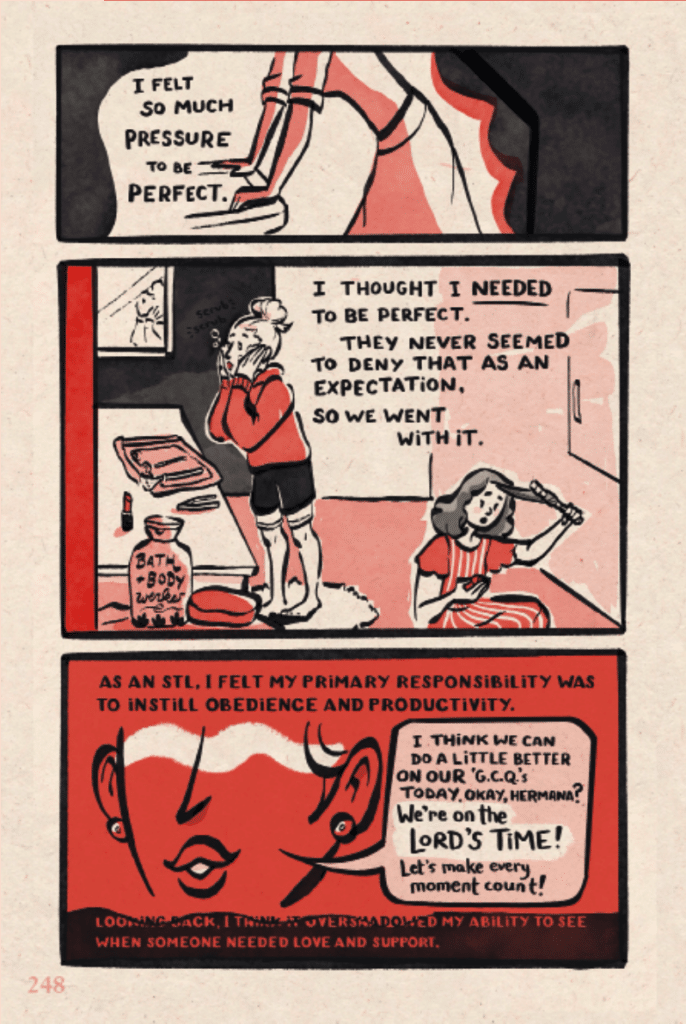
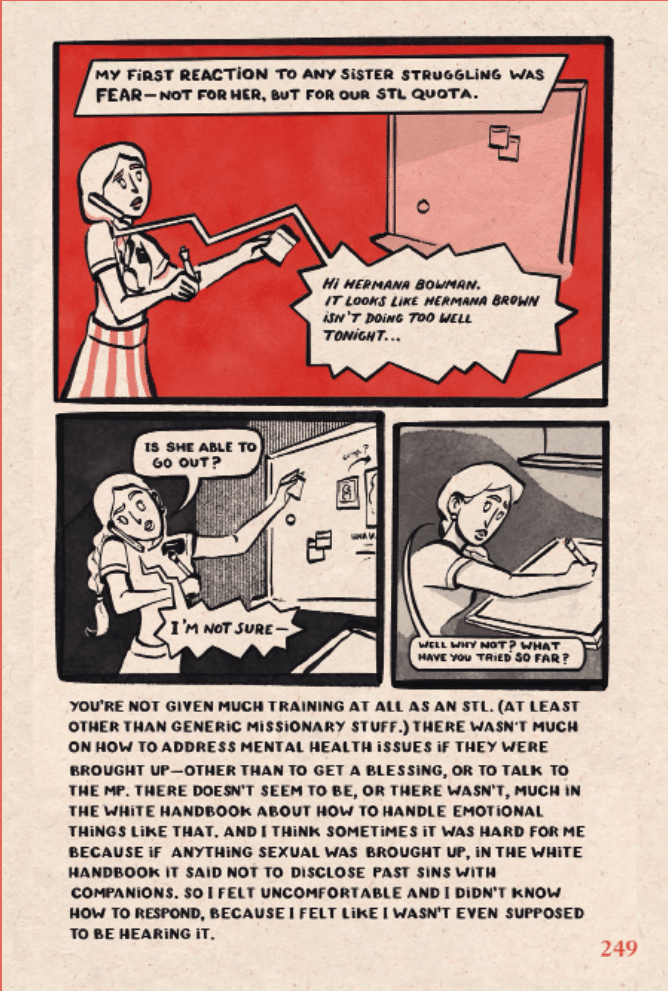
ARTIST STATEMENT
Beyond the Mark
Digital ink and gouache, 10 x 12 in.
Apos is a new graphic novel exploring the complexity inherent to an LDS mission experience, with the hope of fostering discussion, understanding, and healing within the wide spectrum of Mormonism.
Anna M. Wright
frizzbizillustration.com
@frizz_biz
Categories: Preview
Comments (0)
No comments yet.